

If you’ve ever had your email account suspended without warning, watched your open rates crater for no clear reason, or sent a campaign to 50,000 people only to find out half of it landed in spam, you already know that deliverability isn’t just a feature. It’s the whole game.
Most email marketing platforms treat deliverability as an afterthought. Emercury treats it as a core product philosophy.
In this in-depth Emercury review, we’ll go beyond the feature checklist and examine how this platform actually performs, who it’s built for, what makes it different from the dozens of other ESPs on the market, and whether it’s worth the investment for your business.
This review is based on a thorough analysis of the platform’s documented features, official pricing pages, and real verified user testimonials.
What Is Emercury?
Emercury is an email marketing and automation platform that has been operating since 2002, a significant lifespan in the SaaS world. While newer tools compete on flashy design editors and AI gimmicks, Emercury has spent over two decades focused on one core mission: getting emails delivered and converting leads into customers.
The platform is built specifically for performance marketers, lead generators, affiliate marketers, agencies, and businesses in regulated industries like financial services and insurance. If your priority is inbox placement, list hygiene, and behavioral automation rather than polished drag-and-drop templates, Emercury deserves serious consideration.
It offers three core campaign types: Broadcast Messages, Autoresponders, and a Journey Builder for multi-step automation, alongside robust contact management and a deliverability infrastructure that few competitors at this price point can match.
First Impressions and Ease of Use
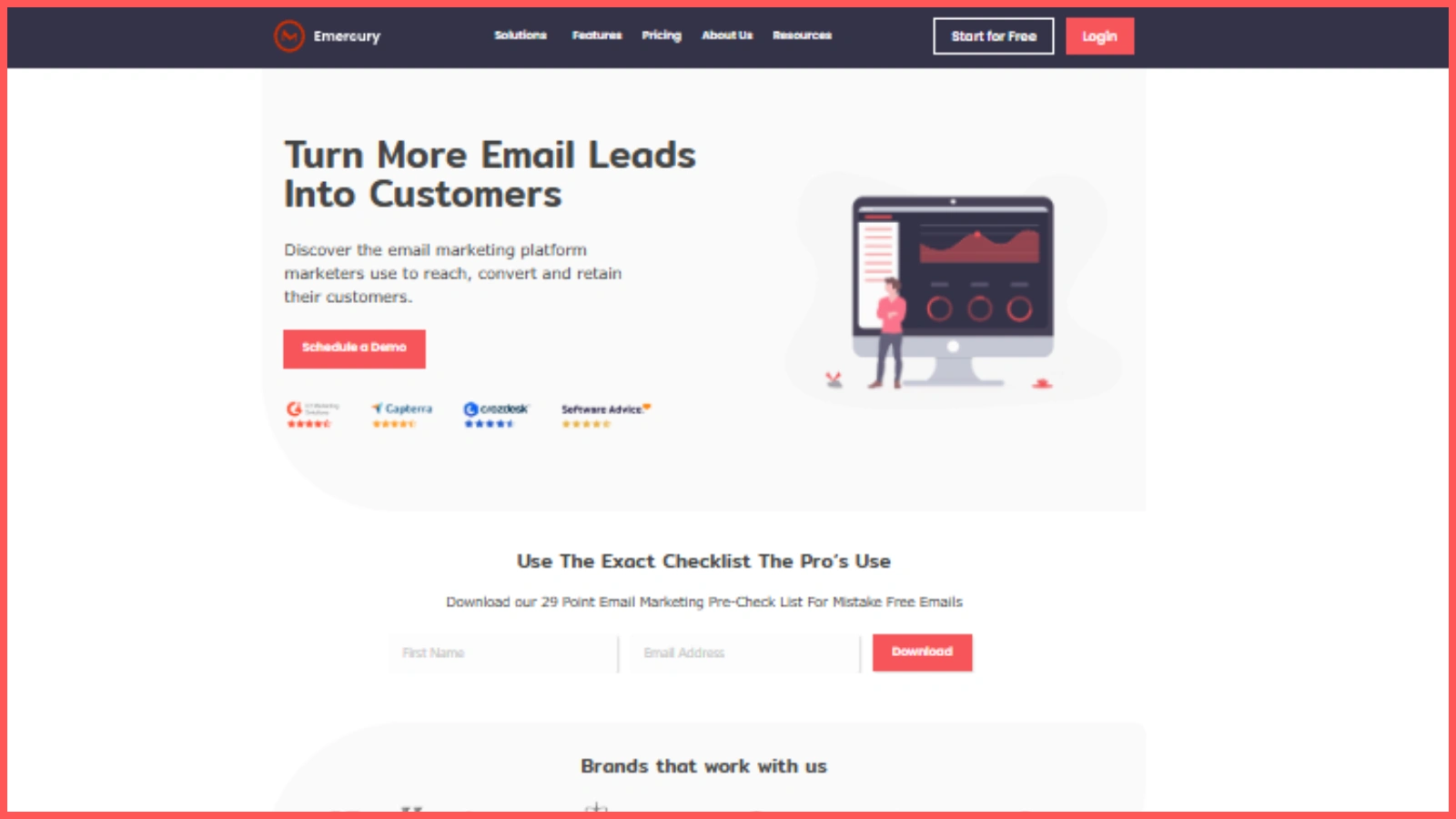
Emercury’s interface is functional and purposeful rather than visually modern. It won’t win design awards, but it’s logically organized and lets experienced marketers move quickly without friction.
New users can get started without a credit card through the Forever Free plan, a genuinely low-barrier way to explore the platform before any financial commitment. The onboarding experience is supported by training videos, a help center, and, for paid plans, onboarding consultations and account setup assistance from Emercury’s team.
For marketers migrating from tools like Mailchimp or Brevo, the learning curve is moderate. The core terminology is familiar, but Emercury’s deliverability-first approach introduces additional considerations upfront, including IP warm-up schedules, suppression list management, and sender profile setup which are features, not obstacles, once you understand the value they deliver.
Email Campaign Creation
Emercury supports three distinct campaign types, each serving a different part of the marketing workflow.
Broadcast Messages are bulk sends to your contact lists, managed through either a drag-and-drop template editor or a direct HTML editor. You can personalize messages at the contact level and segment audiences based on engagement metrics before sending.
Autoresponders handle immediately triggered responses, welcome emails, lead magnet delivery, or follow-ups based on a specific contact action. Setup connects directly to Emercury’s built-in form builder, creating a clean lead capture-to-response workflow.
The Journey Builder is Emercury’s multi-step automation tool. Sequences can be triggered by email behavior (opens, clicks), website visits, form submissions, or contact data changes. The visual editor is clear and practical for marketers who want behavioral automation without needing technical expertise.
One limitation worth stating plainly: Emercury’s template library is narrower compared to platforms like Brevo or Mailchimp. If design-forward, on-brand templates are a top priority, this is a genuine consideration.
Deliverability Emercury’s Core Differentiator
This is where Emercury genuinely separates itself from the competition, and it deserves the most detailed coverage in any honest review.
Deliverability at Emercury is not a checkbox on a feature list. It is the organizational focus, and the platform approaches it through several concrete, verifiable layers:
Dedicated and Failover IPs are included on Pro and Scale plans. This gives high-volume senders control over their sender reputation rather than sharing IP pools with unknown senders on shared infrastructure.
Customized Ramp-Up Schedules are offered through Emercury’s delivery management team. When you begin sending, especially on higher-volume plans, specialists help you scale gradually based on your list quality and subscriber engagement rate a step that many senders skip and later regret when inbox placement collapses.
Advanced Alerting System provides real-time alerts for URL blacklisting, content blocking, DKIM/SPF failures, and deferrals. Problems are surfaced immediately rather than discovered days later, after damage has accumulated.
Email Content Scoring runs campaigns through a proprietary spam checker at the final step before sending. You can make content adjustments and re-test until the score is clean.
ECPM Reporting (Email Cost Per Mille) measures revenue generated per thousand emails sent a metric that puts deliverability performance in direct financial terms rather than abstract engagement numbers. This feature is included on the Scale plan.
It is important to note that dedicated delivery analyst access is a Pro and Scale plan feature. Grow plan users receive chat and ticket support from customer success representatives who are knowledgeable about deliverability, but do not have a named dedicated analyst assigned to their account.
Kirk Wimberly, Director of Operations at an investment management firm, described his experience in a verified G2 review: the Emercury team gave him access to experts who provided solutions and explanations and did the legwork alongside him rather than offering the generic support responses common at other ESPs.
Segmentation and Contact Management
Emercury’s contact management tools are built for marketers managing large, complex, and frequently updated lists.
Subscriber Tagging lets you label contacts based on interests or behavior, then trigger automations or broadcast messages based on those tags. Segmented Lists allow audience division for personalized messaging or A/B testing. Suppression Lists let you exclude specific contacts from selected campaigns, with MD5 suppression list import support essential for affiliate marketers coordinating suppression with networks.
The Never-Email List is a particularly valuable compliance tool: contacts who have opted out of all marketing communications are permanently protected even if accidentally re-imported into a new list.
Additional tools include a Robust Search Function that searches across all campaigns and contact data, and Bulk Unsubscribe for managing list hygiene at scale.
Smart Segments are plan-dependent: Grow includes 1 Smart Segment, Pro includes up to 5, and Scale includes up to 20.
Form Builder and Lead Capture
Emercury includes a built-in form builder supporting pop-up forms, embedded forms, iFrame embeds, and a form button option. For WordPress users, a native plugin handles form embeds without requiring code changes.
What elevates this beyond a basic feature is the direct connection to the Journey Builder: leads captured through a form are immediately entered into an automation sequence. You can tag them by interest, trigger a welcome series, and follow up with targeted offers based on their actions without any manual steps in between.
For businesses whose revenue depends on quickly engaging new leads at the moment of capture, this connection between lead acquisition and nurture is where Emercury delivers tangible value.
Tracking and Analytics
Emercury provides a comprehensive set of campaign metrics available across all plans as base features:
A/B Testing — split test campaigns to identify which version drives higher engagement.
ECPM Reports — available on the Scale plan, this measures revenue per thousand emails, giving campaigns a direct financial performance metric.
Spam Complaint Tracking — tracks not just the aggregate complaint rate but identifies which specific contacts marked an email as spam, enabling proactive list hygiene.
Open Rates, CTR, Hard and Soft Bounces — standard performance metrics available across all plans.
UTM and URL Tracking — monitor traffic driven from email campaigns into your broader analytics stack.
GEO and Device Reporting — available on Pro and Scale plans, adding audience insight by location and device type.
Reporting Retention is plan-dependent: Grow plan users have 6 months of reporting history; Pro and Scale plans have unlimited reporting retention.
All reporting is real-time. Reports are exportable in CSV and HTML formats, and Google Analytics integration is available directly from each campaign.
Integrations
Emercury connects with 200+ applications through native integrations and Zapier, covering CRMs, lead capture tools, form builders, landing page platforms, customer support tools, and social platforms. Developers have full API access in both XML and JSON formats, along with incoming webhook support.
Pro plan users also receive 5 hours of API integration support, which is a practical inclusion for teams building custom workflows.
The integration ecosystem is functional for most marketing stacks. It is smaller than what you’ll find on platforms like ActiveCampaign or HubSpot, so if your workflow depends on less common third-party tools, it’s worth confirming compatibility on Emercury’s integrations page before committing.
Support — A Genuine Differentiator
Customer support at Emercury is structured differently from that at most ESPs, and the difference is meaningful in practice.
Rather than relying solely on a ticketing system, Emercury assigns a dedicated marketing specialist to accounts and, on higher-tier plans, a named Customer Success Manager and Delivery Analyst. Phone support and Skype chat are available on Pro and Scale plans.
On the Grow plan, support is provided through ticket and chat channels with customer success representatives who have deliverability expertise, not a dedicated analyst, but still more substantive than the automated support common at many platforms.
The company’s stated philosophy is that clients are partners, not account numbers, and based on the documented G2 reviews from verified customers, this appears to reflect genuine practice rather than marketing copy alone.
Hamlet K., a Founder and CEO, noted in his verified G2 review that Emercury is a dependable ESP that genuinely cares about client success.
Emercury Pricing
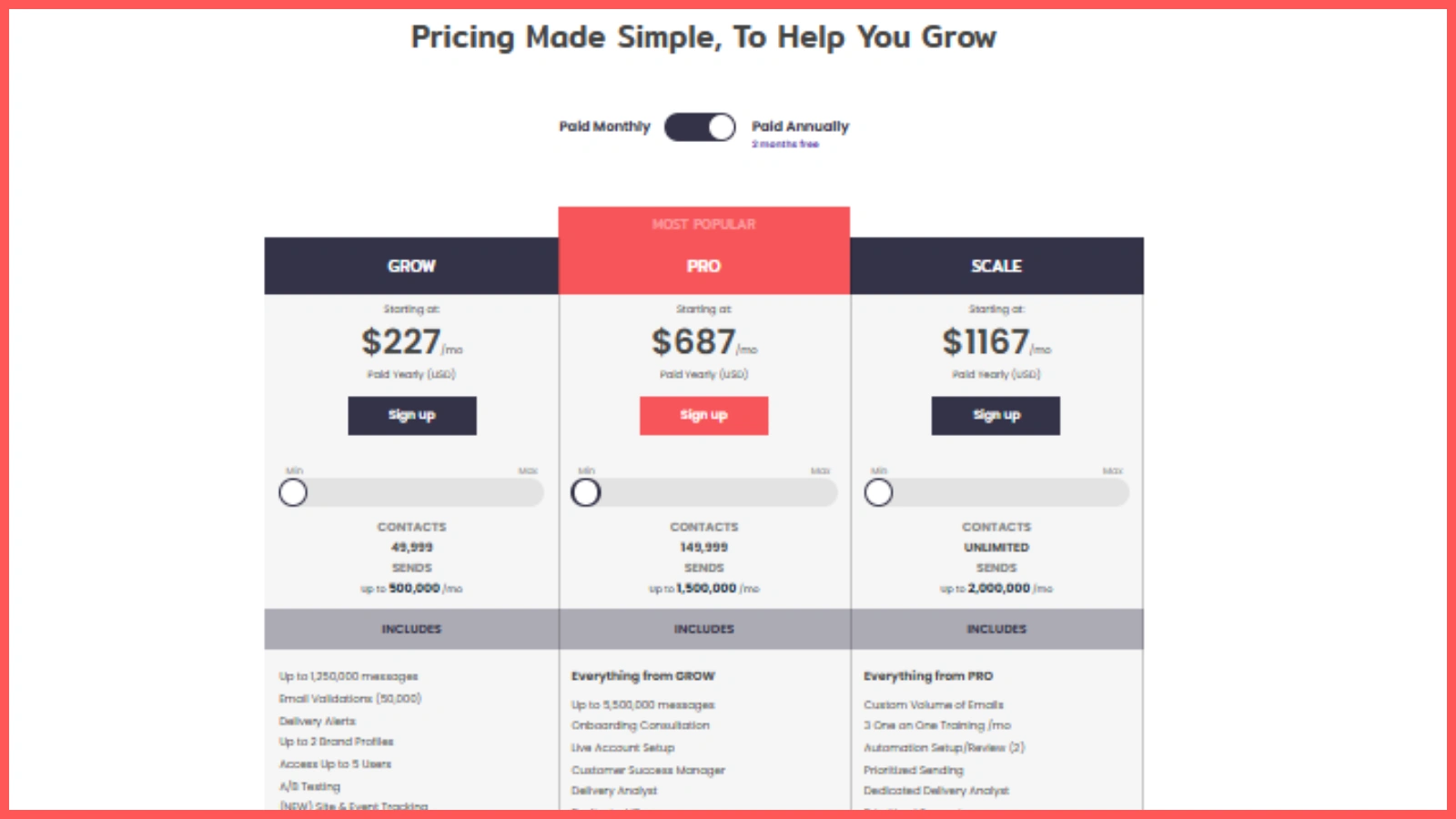
Emercury offers a Forever Free plan and three paid tiers. All paid plans are available monthly with no long-term commitment required. A 10% discount applies to annual prepayment. Non-profits and charities receive a 15% discount.
Pricing scales based on the number of contacts and monthly send volume. The figures below reflect starting monthly prices as shown on the live pricing page.
The Forever Free Core platform features no credit card required. Includes broadcast messaging, autoresponder, Journey Builder, form generator, list management, advanced segmenting, subscriber tagging, and the dynamic template and HTML editors. A legitimate starting point for testing the platform before any financial commitment.
Grow Starting at $275/mo (monthly billing) Up to 49,999 contacts and up to 500,000 sends per month (up to 1,250,000 messages total). Includes 50,000 email validations, delivery alerts, A/B testing, site and event tracking, 1 Smart Segment, ticket and chat support, 200+ app integrations, core API features, Emercury logo removal, and 6 months of reporting retention. Supports up to 5 users and up to 2 Brand Profiles.
Pro — Starting at $825/mo (monthly billing), up to 149,999 contacts and up to 1,500,000 sends per month (up to 5,500,000 messages total). Everything in Grow, plus: onboarding consultation, live account setup, Customer Success Manager, Delivery Analyst, dedicated IP, failover IPs, 1 monthly one-on-one training session, automation strategy consultation, 1 automation setup/review per month, customized ramp-up, phone support, Skype chat support, access for up to 10 users, unlimited reporting retention, GEO and device reporting, 5 hours of API integration support, 150,000 email validations, up to 5 Brand Profiles, and up to 5 Smart Segments.
Scale — Starting at $1,400/mo (monthly billing) Unlimited contacts and up to 2,000,000 sends per month with custom volume options. Everything in Pro, plus: 3 monthly one-on-one training sessions, 2 automation setups/reviews per month, prioritized sending, dedicated delivery analyst, prioritized support, ECPM reporting, 2 email audits per month, 200,000 email validations, uptime SLA, unlimited user access, up to 20 Brand Profiles, and up to 20 Smart Segments.
A 10% discount applies when any plan is prepaid annually.
Emercury Pros and Cons
Pros
- Deliverability infrastructure is a genuine differentiator dedicated IPs, failover IPs, real-time alerts, content scoring, and customized ramp-up.
- Dedicated delivery analysts and Customer Success Managers on Pro and Scale plans
- Three campaign types (Broadcast, Autoresponder, Journey Builder) cover the full lead nurture lifecycle.
- The Forever Free plan requires no credit card.
- Subscriber tagging, suppression lists, MD5 suppression support, and the Never-Email list provide strong compliance tools.
- Real-time reporting with Google Analytics integration
- No long-term commitment required on any plan
- 15% discount for non-profits and charities
- Purpose-built for lead generators, affiliates, agencies, and regulated industries
Cons
- The template library is limited compared to Brevo or Mailchimp.
- Interface feels dated relative to newer platforms.
- A dedicated delivery analyst is a Pro/Scale-only feature. Grow users get chat/ticket support.
- List Hygiene is included only on Pro and Scale; Grow users pay extra.
- ECPM Reporting is a Scale plan feature only
- Pricing is at the higher end, less suited for early-stage businesses on tight budgets.
- Integration ecosystem is smaller than ActiveCampaign or HubSpot.
- Business email address required for registration (free mailboxes like Gmail require domain ownership verification)
Emercury Alternatives
Brevo — more affordable entry point, includes SMS and WhatsApp marketing, better suited for general small business use than high-volume performance marketers focused on deliverability.
ActiveCampaign — deeper CRM integration and more complex automation branching, but significantly higher cost and steeper learning curve.
Mailchimp — well-designed and beginner-friendly, but pricing scales sharply with list size, and deliverability tools are far less specialized.
SendGrid — strong transactional email infrastructure for developers, less suited for behavior-driven marketing campaigns without technical resources.
AWeber — straightforward and affordable for small lists, but lacks the deliverability depth, suppression tooling, and dedicated support structure that Emercury offers.
Final Verdict: Is Emercury Worth It?
Emercury is not trying to compete on design aesthetics or the breadth of its template library. It is a platform built with a specific audience in mind: performance marketers, high-volume senders, lead generators, affiliate marketers, and agencies for whom inbox placement is a revenue variable, not a nice-to-have.
For that audience, Emercury delivers a level of deliverability infrastructure, hands-on support, and operational tooling that most ESPs in this price range simply do not provide. Dedicated IPs, real-time delivery alerts, content scoring, customized ramp-up schedules, and analysts who actually work alongside you — these are the features that matter when email performance directly impacts business outcomes.
It is not the right fit for early-stage businesses on tight budgets, marketers who prioritize template aesthetics, or teams needing a large native integration ecosystem. For those use cases, Brevo or Mailchimp will serve better at a lower price point.
But if deliverability, behavioral automation, and a support team that treats you as a partner rather than a ticket number are your priorities, Emercury is worth a serious look. Start with the Forever Free plan, no credit card required, and see how it compares to what you’re currently using.
Frequently Asked Questions
Are Emercury accounts on shared IPs or dedicated IPs?
It depends on your plan and sending profile. Emercury offers shared, dedicated, and hybrid IP environments. Hybrid environments allow mail to overflow to shared infrastructure during ramp-up, which helps high-volume senders move to dedicated IPs faster. Dedicated IPs are included on Pro and Scale plans.
Do I need to warm up my IP when starting with Emercury?
If you are moving to new IPs or associating your domain with new sending infrastructure, a warm-up process is standard. However, if you plan to send live leads through automated welcome sequences, warm-up is typically not required. Emercury’s delivery specialists will work with you on a customized ramp-up schedule if your situation requires it.
Can I collect leads directly from my website using Emercury?
Yes. You can embed Emercury forms directly on your website using pop-up forms, embedded forms, iFrames, or the form button option. WordPress users can use the native Emercury plugin for seamless form embeds. You can also connect third-party form builders and landing page tools through Emercury’s native integrations or via Zapier and Integromat.
What file formats does Emercury accept for contact imports?
Emercury accepts contacts in .txt (text file), .csv (Comma Separated Values), and .xls (Excel Spreadsheet) formats. For live leads, you can also import contacts via the Emercury API or through connected integration platforms.
Does Emercury offer suppression list management?
Yes. Emercury supports suppression lists with MD5 encryption options. Suppression lists can be applied at the campaign level or at the individual message level within automations, giving you granular control over who receives which communications.