

If your business sends automated emails for order confirmations, password resets, and shipping alerts, you already understand the cost of those messages not arriving. JetSend is built to solve exactly that problem. As a dedicated transactional email service owned by Maropost, it focuses entirely on reliability, speed, and deliverability rather than spreading itself thin trying to do everything. This JetSend review takes an honest look at the platform: what it does well, where it has limits, and whether it’s the right fit for your business.
What Is JetSend?

JetSend is a transactional email platform purpose-built for businesses that need to send high volumes of automated, triggered emails with consistent reliability. It’s not a newsletter tool. It’s not a campaign builder. It’s the infrastructure layer that sits between your application and your customer’s inbox, making sure the emails your system generates actually get there.
Owned by Maropost, a company with deep roots in enterprise marketing infrastructure, it inherits serious technical credibility. The platform is designed around three core pillars: sending at scale, tracking every message in real time, and managing contacts and domains from a single, organized hub.
What makes it interesting isn’t a list of features. It’s the philosophy behind the product. Most email platforms try to serve marketing teams and developers at the same time, often doing neither particularly well. JetSend made a deliberate choice to focus narrowly on transactional email and build that one thing extremely well.
Key Features of JetSend
Delivery Speed and JMTA Infrastructure
Speed is JetSend’s headline claim, and the infrastructure behind it is legitimate. The platform runs on a proprietary relay system called JMTA JetSend Mail Transfer Agent distributed across multiple cloud servers worldwide. This global distribution isn’t just a technical detail; it means your transactional emails route through the nearest available server, cutting down on network latency and making consistent delivery times possible regardless of where your recipients are.
It operates by the “5 seconds or less” rule, which states that transactional emails should hit inboxes within five seconds of being triggered. That benchmark exists because 70% of customers expect exactly that kind of immediacy from automated messages. When someone resets their password or checks out on your site, a 10-minute delay doesn’t just feel slow; it creates friction, generates support tickets, and sometimes loses the transaction entirely.
The JMTA relay is also built to avoid the single-point-of-failure problem. Smaller email infrastructure providers run lean, which means outages at one server can ripple across their entire system. Distributed architecture prevents that. For businesses where email is a functional part of their product experience, that kind of resilience isn’t optional.
API and SMTP Integration
Developers evaluating it will find the integration story genuinely straightforward. The platform supports both REST API and SMTP, which covers essentially every use case, whether you’re integrating with a modern application stack or a legacy system that only speaks SMTP.
The REST API is clean and well-structured. A single POST endpoint to https://app.jetsend.com/api/v1/transmission/email handles transmission, with parameters for recipients, content, tracking domains, and sender identity all clearly organized in the request body. There’s no over-engineered abstraction here, just a direct, sensible interface.
Language support is broad: Node.js, Python, Ruby, PHP, Go, JavaScript, C#, Swift, and cURL are all covered. That range matters for larger organizations with mixed technology environments. You’re not forcing an SDK choice on your engineering team; they work in the language that fits their stack.
The practical upside of this approach is faster integration timelines. An engineer familiar with REST APIs can typically have it connected and sending test emails within a few hours, not days.
Real-Time Tracking and Engagement Insights
After an email is sent, JetSend’s personalized dashboard gives you live visibility into what happens next. Opens, clicks, bounces, and delivery status are all of it is tracked and surfaced in real time using AI-powered algorithms designed to ensure accurate counts, not just rough estimates.
That accuracy distinction matters more than it might seem. Many transactional email platforms report engagement metrics that are meaningfully skewed by bot activity, email preview rendering, and security scanner clicks. JetSend’s approach to filtering these out means the numbers you’re looking at reflect actual human engagement, which makes optimization decisions more reliable.
For a business sending password resets or account activation emails, real-time bounce visibility is especially useful. If a batch of emails is silently failing, you want to catch that within minutes, not discover it because customers are flooding your support channel.
Spam Checker
Before any email goes out, JetSend’s built-in spam checker pre-screens your content and flags issues that could trigger inbox filters. This is a practical tool, not just a defensive feature. Spam filters have become increasingly sophisticated, and small content decisions, such as certain phrases, broken links, and poor text-to-image ratios, can quietly tank your deliverability without ever generating an obvious error.
The spam checker gives you the chance to catch and fix those issues before they affect your sender reputation. For businesses new to managing their own email infrastructure, this kind of guardrail is genuinely valuable. For experienced teams, it’s a fast sanity check that takes seconds and occasionally saves real headaches.
Suppression List Management and Compliance
Suppression list management is automated and built in from the start. Unsubscribes, hard bounces, and spam complaints are handled without manual intervention, which keeps your list clean and your sending reputation intact over time.
The compliance layer goes further than most platforms at this price point. It includes built-in GDPR compliance tools, including mandatory unsubscribe handling that enforces itself rather than leaving it up to the sender to remember. There’s also an automatic account suspension mechanism for senders who exceed spam thresholds, which protects the shared IP infrastructure and, by extension, every other sender on the platform.
That kind of systemic compliance approach is worth noting if your business operates in regulated industries or across multiple markets with varying data protection requirements.
User Interface and Experience
JetSend’s interface is organized around three clear functions: Send, Track, and Manage. Send covers your email transmission setup and API credentials. Track is your analytics and reporting hub. Manage handles contacts, domains, and suppression lists.
That structure is deliberate and effective. There’s no feature sprawl to navigate, no buried settings, no dashboard that tries to surface everything at once. New users can get oriented and functional within minutes rather than spending their first hour figuring out where things live.
The trade-off is that the interface doesn’t have the visual sophistication of some marketing platforms. There’s no drag-and-drop email editor, no campaign calendar, no audience visualization tools. But those things aren’t what it is for. The dashboard reflects the product’s focus: give technical teams what they need to send reliably, track accurately, and manage cleanly, nothing more, nothing less.
For teams accustomed to developer-first tools, this feel is familiar and comfortable. For marketers expecting a Mailchimp-style experience, the interface will feel minimal. That’s not a criticism, just an honest expectation-setter.
Dedicated IPs: When You Need One and What It Costs
It offers dedicated IP addresses at $70 per IP per month, with up to 5 IPs supported per standard account. Enterprise accounts can request custom configurations beyond that limit.
A dedicated IP means your sending reputation belongs entirely to you. On a shared IP, your deliverability is partly influenced by the behavior of every other sender using that address. If another sender on the same IP gets flagged for spam, your emails can suffer for it — even if your own practices are clean. With a dedicated IP, there’s no exposure to other senders’ mistakes.
For businesses sending fewer than 300,000 emails per month, dedicated IPs are optional. Above that threshold, JetSend requires at least one dedicated IP as part of the plan. At that scale, the requirement makes sense: high-volume senders have more to lose from shared reputation risk, and dedicated infrastructure becomes a practical necessity rather than a premium add-on.
What’s notable about JetSend’s dedicated IP offering is the support model. Each dedicated IP account comes with a dedicated deliverability team that actively manages and monitors sending reputation. That’s a meaningful differentiator. Most platforms hand you an IP and leave the reputation management entirely to you. Having a team whose job it is to maintain your deliverability standards removes a real operational burden, especially for businesses without in-house email expertise.
JetSend Pricing
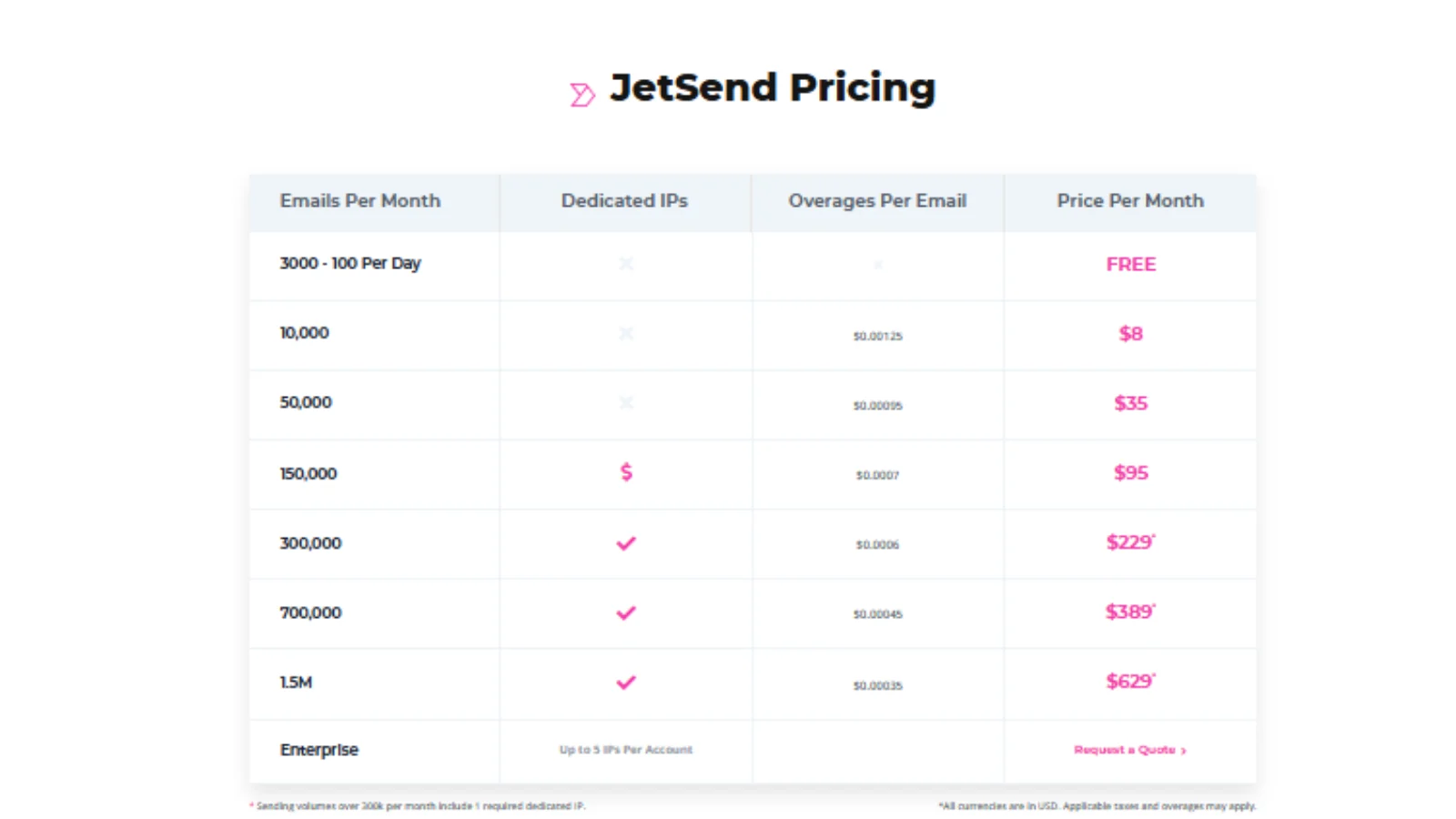
It uses a volume-based pricing model that scales with your monthly sending needs. The entry point is a free tier, and paid plans increase in capacity with decreasing per-email costs at higher volumes.
*Plans at 300,000+ emails per month include one required dedicated IP. All pricing in USD. Applicable taxes and overages may apply.
The free plan deserves credit for being genuinely functional rather than artificially crippled. You get full platform access, API included, just capped at 100 emails per day and 3,000 per month. That’s enough to complete a real integration, run deliverability tests, and evaluate the platform’s behavior before spending anything.
The paid tier pricing is competitive when you compare it against alternatives in the transactional email space. At $8 per month for 10,000 emails, the entry-level paid plan is cheaper than many competitors while still including the core deliverability infrastructure. As volumes grow, the per-email rate steps down considerably from $0.00125 at 10,000 emails to $0.00035 at 1.5 million, which reflects a sensible structure for businesses with scaling send volumes.
One thing to factor into your cost planning: if you’re at or approaching the 300,000 email threshold, the mandatory dedicated IP adds $70 per month to your base plan cost. The $229 plan effectively becomes $299 once that’s included. It’s not hidden. The app notes it clearly, but it’s worth accounting for in your actual budget math.
Strengths of JetSend
Deliverability is the core product, not an afterthought. JetSend sends billions of emails monthly with a 98% deliverability rate. The infrastructure, distributed cloud servers, JMTA relay, dedicated IPs with active management, is built from the ground up for this one job. That focus shows in the results.
Developer experience is genuinely good. Clean REST API, SMTP support, nine language SDKs, and a straightforward request structure make integration fast and low-friction. Engineering teams aren’t fighting the platform to get it working.
Compliance tooling is robust for the price point. Automated suppression, GDPR tools, mandatory unsubscribe handling, and spam threshold enforcement. Most of this is handled automatically rather than relying on you to configure it correctly.
The free plan is real. Full API access at no cost, capped only on volume. That’s a legitimate way to evaluate the platform rather than a feature-stripped trial designed to force an upgrade.
Active deliverability support on dedicated IP plans. Having a team actively managing your sending reputation is a meaningful operational advantage, particularly for businesses without dedicated email infrastructure expertise.
Weaknesses and Limitations
Strictly transactional. It does not offer marketing automation, campaign management, audience segmentation, or a visual email builder. If those are requirements, this platform alone won’t cover them, and you’ll need to pair it with a separate tool.
Analytics may be less granular on lower-tier plans. It provides real-time tracking across all plans, but businesses with advanced reporting requirements, detailed segment analysis, long-term trend data, and export-heavy workflows may find higher-tier plans better suited to those needs.
Dedicated IP costs need to be factored in. The $70 per IP per month fee is reasonable given what you get, but it adds real cost at higher sending tiers where IPs are mandatory. Businesses budgeting at the 300k+ tier should account for this from the start.
Not the right fit for non-technical teams. JetSend’s setup assumes API familiarity. If your team doesn’t have a developer to handle integration, onboarding will be slow. The platform isn’t designed for marketers who want to build and send without touching code.
Top Alternatives to JetSend for Email Marketing and Automation
Stripo: A powerful all-in-one email design platform for creating responsive emails with a drag-and-drop editor.
AWeber: A user-friendly platform for email automation, newsletters, and subscriber management.
Smartrmail: Built for eCommerce, offering dynamic email automation and product-based campaigns.
ActiveCampaign: A comprehensive marketing tool that combines email, CRM, and customer journey automation.
EmailOctopus: A budget-friendly solution for email marketing and transactional messages with a focus on simplicity.
Use Cases Where JetSend Performs Best
E-commerce operations. An online store sending order confirmations, shipping notifications, and return processing emails benefits directly from its speed and deliverability guarantees. A delayed order confirmation creates customer anxiety and support volume. JetSend is designed specifically to eliminate that problem.
SaaS products. Account verification flows, password resets, billing alerts, and usage notifications are the lifeblood of any SaaS product’s communication layer. It gives development teams a clean, reliable API to power those flows without managing their own mail server infrastructure.
High-volume senders with compliance requirements. Businesses in regulated industries, fintech, healthcare-adjacent, or multi-market operators under GDPR benefit from its built-in compliance architecture. Automatic suppression and GDPR tooling reduce legal exposure without requiring custom development.
Development teams moving off shared infrastructure. If your application is currently using a generic shared SMTP setup and experiencing deliverability inconsistency, JetSend offers a clear upgrade path with dedicated infrastructure, better monitoring, and active deliverability management at a price point that scales reasonably.
Final Verdict
JetSend is a well-built, focused transactional email service that does exactly what it says it does. The deliverability infrastructure is serious, the API is genuinely developer-friendly, the compliance tooling handles real operational requirements, and the pricing is competitive at virtually every tier.
The product’s greatest strength is also what defines its limits: it’s built for one thing. If transactional email is your primary need, it is a strong, reliable choice that doesn’t require you to pay for a bloated marketing suite you won’t use. If you need marketing automation on top of transactional sending, you’ll need to plan around that gap either by pairing JetSend with another tool or by evaluating whether Maropost’s broader product ecosystem covers your full requirements.
For businesses where automated emails are a core part of the product experience, and reliability isn’t negotiable, it earns a clear recommendation.
Ready to Get Started?
JetSend’s free plan gives you full platform access, including the API, with up to 3,000 emails per month. It’s a legitimate way to test the integration, verify deliverability against your use case, and decide whether upgrading makes sense before committing to a paid tier. When you’re ready to scale, upgrading is handled directly within the platform.
Start sending free today and see how It performs for your stack.
FAQ
What types of emails can JetSend handle?
JetSend specializes in transactional emails like order confirmations, password resets, and shipping notifications.
How does JetSend ensure reliable email delivery?
JetSend uses a global server infrastructure with proprietary systems to ensure fast, reliable delivery of automated emails.
Does JetSend integrate with other platforms?
Yes, JetSend integrates with popular platforms like Shopify, BigCommerce, WooCommerce, and Maropost, as well as CRMs like Mailchimp and Klaviyo.
What is JetSend’s pricing structure?
JetSend offers competitive pricing based on email volume, with a free plan that allows up to 3,000 emails per month.
Can JetSend be used for marketing emails?
No, JetSend focuses solely on transactional emails, but it can be paired with other marketing tools for full campaign management.